
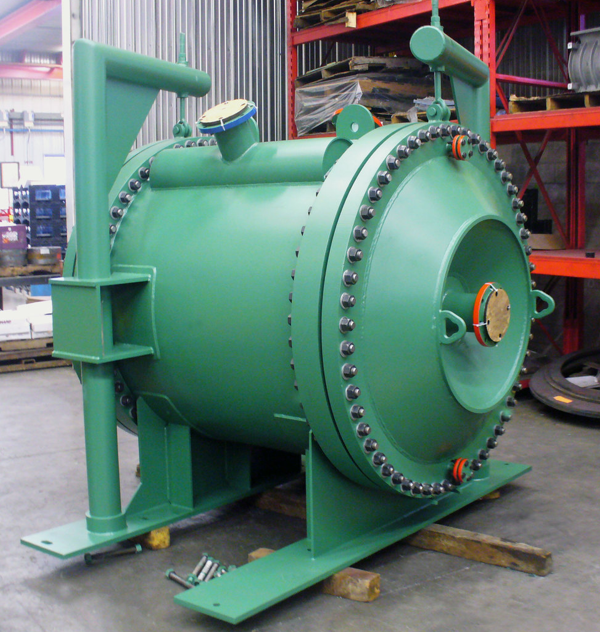
Spiral Heat Exchanger for Zinc Sulphate Solution Heating
In zinc sulphate processing lines, the heating stage before concentration, reaction control, or crystallization requires a heat exchanger that can handle corrosive liquid media, maintain stable outlet temperature, and continue operating reliably even when scaling or fouling risks increase over time.
For this type of duty, a spiral heat exchanger is often a highly effective solution when saturated steam is used to heat zinc sulphate solution from medium temperature to a higher process temperature range. The design focus is not only on heat transfer performance, but also on anti-fouling capability, corrosion resistance, service life, and maintenance practicality.
Application Background
Zinc sulphate solution heating is a typical chemical process duty where the exchanger must operate under a combination of demanding conditions. The process fluid may contain dissolved salts, suspended impurities, or scaling tendencies, while the heating side is usually saturated steam or low-pressure steam condensate service.
In actual operation, users are not only concerned about whether the solution can be heated to the target temperature, but also whether the exchanger can maintain performance over time without excessive fouling, leakage, corrosion, or pressure drop increase.
- Corrosive zinc sulphate liquor can challenge conventional materials
- Scale formation may gradually reduce heat transfer efficiency
- Viscous or impurity-containing solution can increase fouling risk
- Steam heating requires stable condensation performance and safe pressure design
- Unplanned shutdowns create high production and maintenance costs
Why Choose a Spiral Heat Exchanger?
A spiral heat exchanger is especially suitable for this type of duty because its flow path and welded construction offer strong advantages for corrosive liquid heating applications.
1. Continuous Single-Channel Flow Path
Unlike some multi-channel exchanger configurations, the spiral channel design forces the process fluid through a continuous passage. This helps reduce dead zones and lowers the chance of local deposition, making the unit more tolerant of scaling and suspended solids.
2. Better Fouling Resistance
Zinc sulphate applications may experience crystallization tendency, salt deposition, or dirt accumulation over time. The curved flow path of a spiral plate heat exchanger promotes turbulence at relatively moderate velocities, helping reduce build-up and improve long-term thermal stability.
3. Efficient Steam Condensation Heating
For steam-to-liquid heating duty, spiral heat exchangers can provide strong heat transfer performance with a compact installed footprint. The counter-current arrangement is favorable for maintaining an effective temperature profile and achieving a stable solution outlet temperature.
4. Fully Welded Structure for Demanding Service
In chemical plants, sealing reliability is critical. A welded spiral exchanger reduces the number of leakage-sensitive joints compared with some alternative technologies, which is especially valuable where corrosive media and thermal cycling are present.
Why Not Use Other Heat Exchanger Types First?
Other exchanger types can be used in certain chemical heating systems, but for zinc sulphate solution duty, the spiral design often becomes more attractive when fouling resistance and corrosion management are key concerns.
- Gasket Plate Heat Exchangers offer high efficiency, but gasket compatibility and long-term sealing reliability must be carefully considered in corrosive chemical service.
- Shell & Tube Heat Exchangers are robust, but they may require larger footprint and can be less favorable when process-side fouling is concentrated and cleaning intervals become frequent.
- Shell & Plate Heat Exchangers are effective in many clean or moderately demanding duties, but for heavier fouling or more deposition-prone solutions, a spiral channel design can offer a more suitable process-side path.
Material Selection for Zinc Sulphate Heating
Material selection is one of the most important parts of the project. Zinc sulphate solution may present different corrosion risks depending on concentration, pH, impurities, chloride content, operating temperature, and cleaning method. Because of this, the final material should always be confirmed based on actual process data.
In practice, the following materials are commonly considered for spiral heat exchanger construction in chemical solution heating service:
- SS304 / SS316L for relatively mild conditions and lower corrosion risk media
- 904L where stronger corrosion resistance is needed
- Titanium for particularly aggressive liquid compositions or chloride-sensitive environments
- Duplex or special alloys for customized high-corrosion duties
On the steam side, material compatibility with condensate conditions, pressure, and fabrication requirements must also be considered. If the system includes aggressive cleaning chemicals, the cleaning regime should be included in the material review as well.
Typical Design Considerations
When designing a spiral heat exchanger for zinc sulphate solution heating, the main engineering inputs usually include:
- Process fluid composition and concentration
- Flow rate of zinc sulphate solution
- Inlet and outlet temperature requirements
- Steam pressure and condensation conditions
- Allowable pressure drop on both sides
- Scaling tendency and expected maintenance interval
- Material corrosion allowance and design life target
These factors determine the spiral channel geometry, plate spacing, heat transfer area, nozzle arrangement, mechanical design pressure, and material specification. In many retrofit projects, nozzle orientation and installation footprint are also important so that the new exchanger can be integrated without major piping changes.
Benefits of the Spiral Solution in This Application
For zinc sulphate heating service, the spiral heat exchanger solution can deliver several practical advantages:
- Stable heating performance for corrosive chemical solution
- Improved resistance to scaling and deposit accumulation
- Compact structure compared with many traditional designs
- Reliable welded construction for demanding process environments
- Lower maintenance burden in fouling-prone service
- Flexible material selection based on actual corrosion conditions
Conclusion
For zinc sulphate solution heating duties, a spiral heat exchanger is often one of the most suitable technologies when the process requires a balance of high heat transfer efficiency, anti-fouling capability, corrosion resistance, and reliable long-term operation.
Compared with more conventional exchanger choices, the spiral design is particularly valuable when the process side is prone to scaling, when welded construction is preferred, and when material selection must be tailored to a corrosive chemical environment.
If you are evaluating equipment for zinc sulphate solution heating, chemical liquor heating, or other corrosive process applications, HEXNOVAS can provide a customized spiral heat exchanger solution based on your actual operating conditions.


