
Liquid Cooling
Designed for high-density racks, AI compute loads, and direct-to-chip cooling systems where heat must be removed efficiently with liquid loops instead of relying only on room air.
Data center cooling solutions, liquid cooling heat exchangers, CDU heat exchangers, direct-to-chip cooling, waterside economizer heat exchangers, free cooling heat exchangers, natural water cooling heat exchangers, data center heat reuse systems, AI data center thermal management, high density rack cooling, plate heat exchangers for data centers.
Data center cooling is no longer limited to conventional chilled water loops and room-level air management. As rack densities continue to rise, operators increasingly adopt liquid cooling, waterside economizers, natural water-assisted cooling, and heat reuse strategies to improve thermal stability, reduce energy use, and recover valuable waste heat. Instead of starting with a product list, this page starts with the cooling architecture itself and then maps the most suitable heat exchanger technologies for each stage of the system.
In modern data centers, buyers do not begin with a question such as “Do I need a brazed plate heat exchanger or a gasketed plate heat exchanger?” They begin with a system-level question: “Which cooling method fits my density, water quality, reliability target, and energy strategy?”
That is why a strong data center cooling page should be organized around operating architecture first, then around equipment selection. Once the architecture is clear, the correct heat exchanger technology becomes much easier to define. This structure also aligns better with how engineers, EPC contractors, and facility operators search online for terms such as liquid cooling, CDU heat exchanger, waterside economizer, and heat reuse from data centers.
The most common high-value cooling routes for data centers can be grouped into four practical categories: liquid cooling, waterside economizers, natural water cooling, and heat reuse. Each route has a different thermal objective and a different heat exchanger requirement.
Designed for high-density racks, AI compute loads, and direct-to-chip cooling systems where heat must be removed efficiently with liquid loops instead of relying only on room air.
Used to reduce chiller operation by transferring heat through plate heat exchangers when outdoor or facility water conditions permit partial or full free cooling.
Uses rivers, lakes, seawater, or other natural water sources to support data center cooling through an isolated heat transfer interface that protects the internal loop.
Recovers waste heat from data center cooling loops for district heating, process water preheating, heat pump integration, or other energy reuse strategies.
Liquid cooling is increasingly used where conventional air-based cooling becomes inefficient, especially in AI clusters, GPU racks, and high-density computing zones. In these systems, heat is collected through cold plates, rear door systems, or liquid distribution modules and then transferred to a facility water loop through a dedicated heat exchanger.
The most critical position is often the CDU (Cooling Distribution Unit), where a liquid-to-liquid heat exchanger isolates the facility side from the IT side. This isolation improves control, protects sensitive electronics-side coolant circuits, and allows different pressure or water chemistry conditions on each loop.
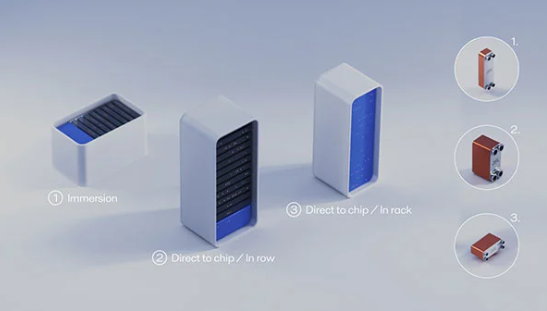
Server cold plate / rear door loop → secondary coolant loop → CDU heat exchanger → facility water / chilled water loop.
This arrangement keeps the IT-side loop controlled and isolated while allowing efficient heat rejection to a broader plant cooling system.
A waterside economizer reduces reliance on mechanical chillers by using favorable environmental or plant-side water temperatures to reject heat through an intermediate heat exchanger. In many climates, this strategy can significantly improve annual system efficiency and lower operating cost.
The heat exchanger in this section must deliver efficient thermal transfer with low approach temperature while keeping facility and process loops separated. This is especially important when the economizer loop and the data hall loop operate under different water treatment conditions.
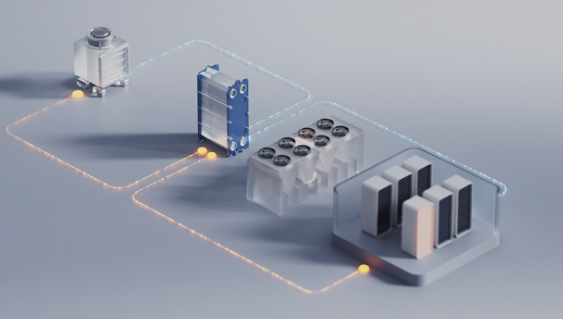
Waterside economizers allow partial or full free cooling during favorable seasons, cutting compressor runtime and supporting lower PUE targets in well-optimized facilities.
GPHE is usually the first choice for central plant integration because it combines high efficiency with serviceability. BPHE can also be effective in compact packaged systems or smaller modular plants.
In some regions, data centers can use nearby natural water resources as part of the thermal management strategy. This may include river water, lake water, seawater, or other stable natural cooling sources. The internal data center loop should not be exposed directly to these external sources. Instead, the safest approach is to create a protected transfer barrier through a dedicated heat exchanger.
Here, the heat exchanger must be selected not only for thermal performance, but also for corrosion resistance, fouling risk, cleanability, and service conditions. Material selection becomes much more important when chloride concentration, suspended solids, or biological fouling risk are present.
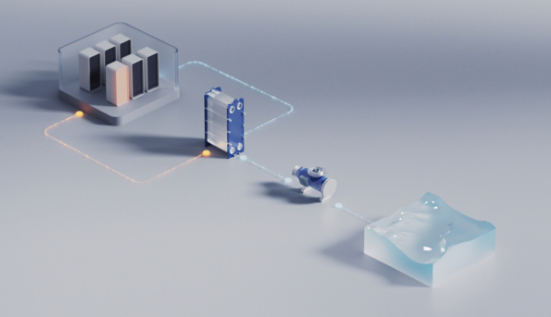
Natural water cooling projects require careful review of water chemistry, fouling allowance, design pressure, filtration level, and maintenance method before final exchanger selection.
Heat reuse changes the role of a data center from a pure cooling load to an energy resource. Instead of rejecting all heat to atmosphere, a properly designed system can transfer usable thermal energy to another process, such as district heating, domestic hot water preheating, process water heating, or a heat pump-based recovery loop.
This is especially relevant as more owners seek to improve sustainability metrics, recover energy value from AI infrastructure, and lower total lifecycle cost. The heat exchanger becomes a strategic component because it must transfer heat efficiently while maintaining isolation between the data center loop and the recovery loop.
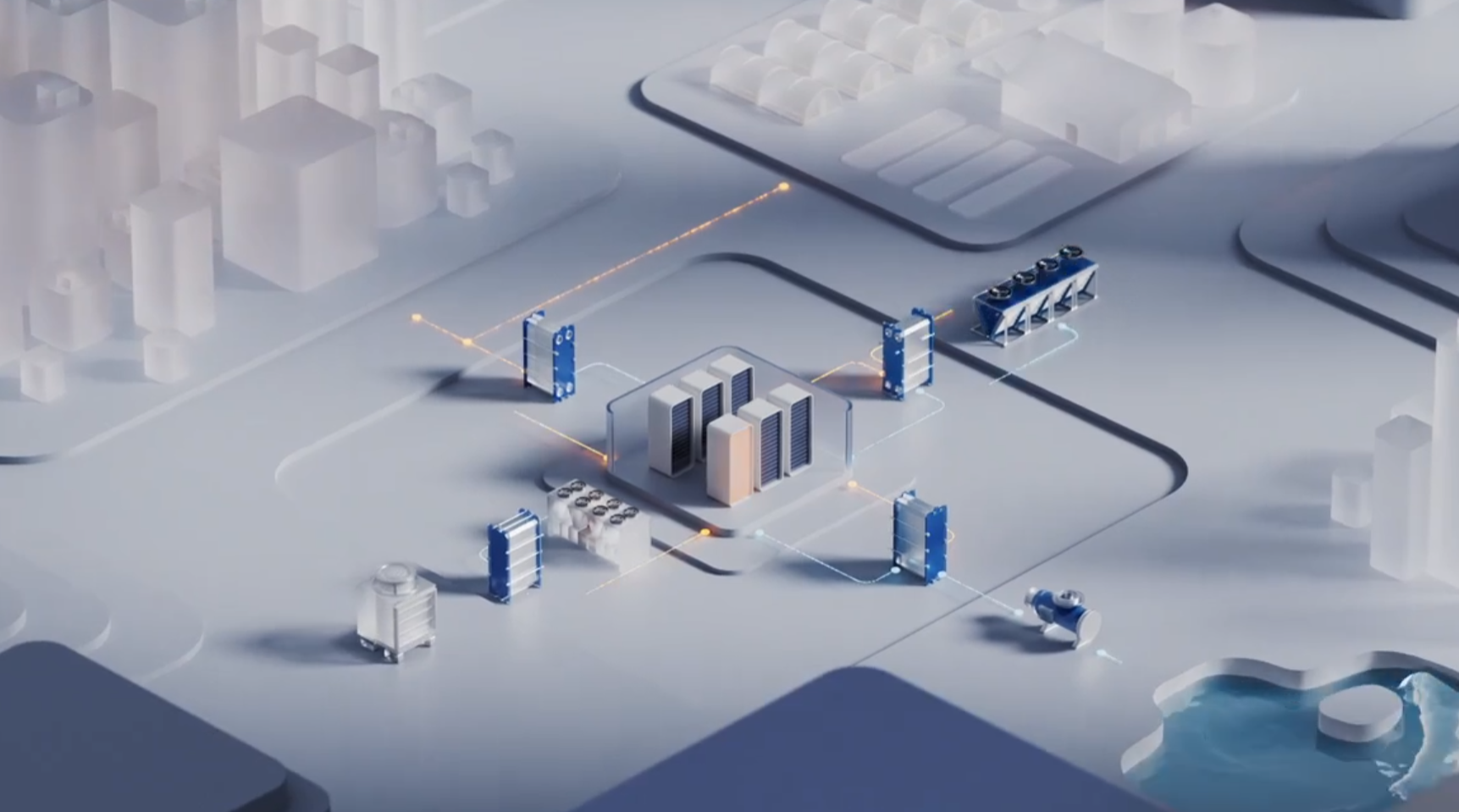
Heat reuse is not only an add-on. It can shape the entire thermal design philosophy of a modern data center, influencing supply temperatures, loop arrangement, exchanger sizing, and long-term energy strategy.
Once the cooling architecture is defined, the next step is to match the exchanger to the actual operating conditions. The table below summarizes typical selection logic for major data center cooling scenarios.
| Cooling Scenario | Typical Duty | Preferred Heat Exchanger | Main Reason |
|---|---|---|---|
| CDU / direct-to-chip loop isolation | Compact liquid-to-liquid transfer | BPHE | Compact footprint, high efficiency, fast thermal response |
| Large secondary liquid cooling loop | Scalable plant-side integration | GPHE | Easy maintenance, expandable capacity, efficient central plant use |
| Premium high-reliability liquid cooling skid | Compact and robust isolation duty | Plate & Shell | High structural strength with compact plate-based efficiency |
| Waterside economizer | Free cooling heat transfer | GPHE / BPHE | Strong performance at low approach temperature with loop isolation |
| Natural water interface | External source isolation | Titanium GPHE / Shell & Tube | Corrosion resistance, maintainability, or utility-side robustness |
| Heat reuse and heat recovery loop | Transfer waste heat to useful load | GPHE / BPHE / Plate & Shell | Flexible integration depending on loop size and recovery strategy |
In many compact CDU systems, a brazed plate heat exchanger is a strong choice because it combines high thermal efficiency with a compact footprint. For larger or more service-oriented systems, a gasketed plate heat exchanger or plate & shell unit may also be selected.
Loop isolation allows the facility side and the IT equipment side to operate with different pressures, water chemistry, and maintenance strategies. It improves reliability and protects sensitive cooling circuits serving servers or cold plates.
Yes. Many facilities use waterside economizers or other free cooling strategies when climate or source water conditions are suitable. A well-selected plate heat exchanger is often central to this approach.
Yes. Waste heat can be transferred to district heating networks, heat pump systems, domestic hot water preheating, or other secondary uses, provided the thermal level and integration design are suitable.
Not always. It depends on site location, water availability, water chemistry, environmental rules, filtration level, and corrosion risk. The exchanger material and cleanability must be reviewed carefully before implementation.
Whether you are evaluating CDU integration, liquid cooling loop isolation, waterside economizers, natural water-assisted cooling, or heat reuse, HEXNOVAS can help map the right heat exchanger solution to your cooling architecture.


