
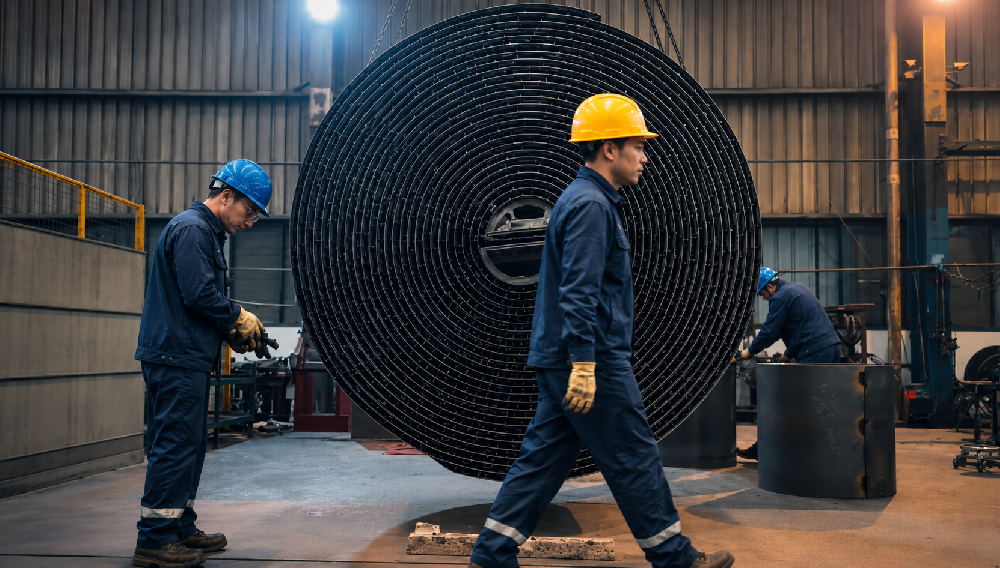
Spiral Heat Exchanger Structure, Flow Path and Manufacturing
These engineering visuals help users quickly understand how a spiral heat exchanger is built, how the counter-current flow works, and how HEXNOVAS supports fabrication, inspection and delivery.

What Is a Spiral Heat Exchanger?
A spiral heat exchanger is a compact, fully welded heat exchanger formed by rolling two metal plates into concentric spiral channels. One fluid flows from the center to the outside, while the other flows from the outside to the center, creating efficient counter-current heat transfer in a single continuous passage.
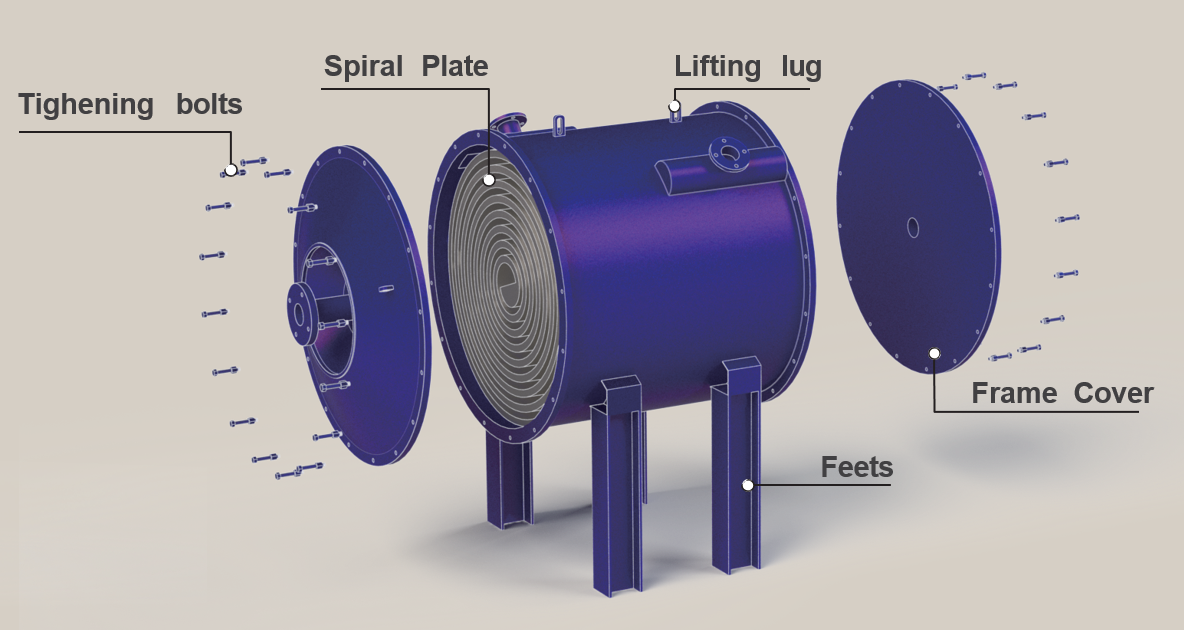
No Bypass Path
Each medium travels through one continuous channel. If fouling begins to form, local velocity increases through the restricted area, helping remove deposits instead of allowing flow to bypass the blockage.
High Heat Recovery
The spiral geometry supports close temperature approaches and strong thermal performance, making it suitable for heat recovery, product heating, cooling and condensing duties.
Robust Industrial Construction
Welded construction helps handle demanding industrial services, including viscous media, slurries, suspended solids, wastewater streams and aggressive process liquids.
How the Spiral Plate Heat Exchanger Works
The heat exchanger uses two isolated spiral passages. The hot side and cold side do not mix; heat is transferred through the spiral plate wall while both fluids maintain controlled flow paths.
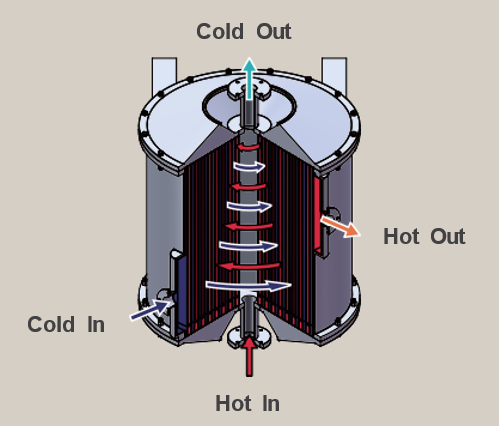
Hot Fluid Enters
The process fluid typically enters from the center or periphery depending on the duty and cleaning requirement.
Cold Fluid Counter-Flows
The service fluid flows in the opposite direction, improving temperature approach and heat recovery.
Turbulence Is Maintained
The curved spiral channel promotes turbulence and reduces stagnant areas where deposits usually build up.
Self-Cleaning Effect
When deposits narrow the channel, velocity rises locally and creates a scrubbing action that helps keep the channel open.
Why Spiral Heat Exchangers Are Used for Difficult Fluids
Spiral heat exchangers are selected when process reliability, fouling resistance and energy recovery are more important than simply choosing the lowest initial equipment cost.
- Reduced risk of clogging in fouling, fibrous or particle-laden fluids.
- High thermal efficiency with compact footprint.
- Single-channel design minimizes flow maldistribution.
- Good option for sludge, slurry, viscous liquid and wastewater duties.
- Suitable for liquid-to-liquid heat transfer and selected vapor condensing duties.
- Lower maintenance frequency compared with many conventional designs.
- Accessible covers can be configured for easier mechanical cleaning.
- Available in carbon steel, stainless steel, duplex and high-alloy materials.
Spiral Heat Exchanger Specifications
The following values are typical design ranges. Final selection depends on duty, fluids, fouling tendency, allowable pressure drop, corrosion requirement, cleaning access and applicable pressure vessel code.
| Item | Typical Range / Options | Selection Notes |
|---|---|---|
| Spiral plate width | 200 to 2000 mm | Selected according to heat transfer area, flow rate and pressure drop. |
| Plate thickness | 2.0 to 6.3 mm | Depends on pressure, temperature, material and mechanical strength requirement. |
| Channel spacing / plate gap | 5 to 38 mm | Larger gaps are used for viscous fluids, solids, fibers and high fouling risk. |
| Heat transfer area | 1 to 500 m² per unit | Larger duties can be handled by multiple units or project-specific designs. |
| Shell diameter | Up to 2500 mm | Actual diameter depends on required area and channel geometry. |
| Design temperature | -100°C to 400°C | Material, gasket/cover sealing arrangement and code design must be checked. |
| Design pressure | Full vacuum to 40 barg | Pressure capability depends on size, thickness, channel design and code. |
| Materials | Carbon steel, SS304, SS316L, Duplex 2205, 904L, 254 SMO, AL6XN, titanium, nickel alloys | Material selection should match chloride level, pH, temperature and corrosion risk. |
For corrosive or high-fouling fluids, please provide fluid composition, solids content, viscosity, inlet/outlet temperatures, pressure, flow rate and cleaning method for engineering review.
Typical Spiral Heat Exchanger Applications
Spiral heat exchangers are widely used in industrial processes where heat transfer is challenged by fouling, suspended solids, high viscosity or low pressure drop requirements.
Wastewater & Sludge
Sludge heating, sludge cooling, digester heating, wastewater heat recovery and effluent cooling.
Chemical & Petrochemical
Feed-to-bottoms interchangers, product coolers, process heaters and fouling hydrocarbon services.
Pulp & Paper
Black liquor, green liquor, fibrous fluids, condensate recovery and process water heating.
Edible Oil & Oleochemical
Vegetable oil processing, fatty acid duties, viscous liquids and heat recovery systems.
Metals & Mining
Slurry cooling, mineral processing liquids, dirty water circuits and corrosive process streams.
Vapor Condensing
Overhead condensers, reflux condensers and vapor mixtures with inert gases where low pressure drop is important.
Spiral Heat Exchanger vs. Shell-and-Tube vs. Plate Heat Exchanger
Each heat exchanger type has its own best application range. Spiral heat exchangers are especially valuable when fouling resistance and stable operation are the key decision factors.
Best for Fouling Duties
Excellent for slurries, viscous media, wastewater, suspended solids and heat recovery with compact installation.
Best for Broad Code Flexibility
Robust and familiar, but larger footprint and lower heat transfer efficiency may increase cost in dirty services.
Best for Clean Liquid Duties
High efficiency and easy expansion, but narrow channels and gaskets are not ideal for many slurry or heavy fouling fluids.
Materials for Spiral Heat Exchangers
Material selection is based on corrosion resistance, mechanical strength, temperature, pressure and cleaning chemicals.
| Material | Typical Use | Engineering Consideration |
|---|---|---|
| Carbon Steel | Non-corrosive water, oil and general industrial services | Economical option where corrosion allowance is acceptable. |
| SS304 / SS316L | General chemical, food-related and clean industrial fluids | SS316L provides better chloride resistance than SS304, but chloride limit must still be checked. |
| Duplex 2205 | Chloride-containing or higher-strength applications | Good balance of strength and corrosion resistance for many industrial liquids. |
| 904L / 254 SMO / AL6XN | More aggressive chloride or acidic services | Used when standard stainless steel is not sufficient. |
| Titanium / Nickel Alloys | Seawater, brine, selected acids and highly corrosive processes | Project-specific corrosion review is required before quotation. |
From Material Preparation to Final Inspection
HEXNOVAS supports spiral heat exchanger projects from thermal selection and mechanical design to fabrication coordination, testing documentation and export delivery.

Duty Review & Thermal Selection
Review flow rate, temperature program, pressure drop, fouling risk, viscosity, solids content, corrosion conditions and cleaning requirements.
Material & Channel Design
Select plate material, plate thickness, channel spacing, nozzle arrangement, cover type and pressure design basis.
Plate Rolling & Welding
Form two spiral channels from metal plates, weld the channel structure, install covers, nozzles and support components.
Inspection & Pressure Testing
Carry out dimensional checks, weld inspection, pressure test, leakage test and document preparation according to project requirements.
Packing & Export Support
Provide packing, nameplate, drawing, test report, material certificate and export documentation as required by the order.
Information Required for Spiral Heat Exchanger Sizing
To select a spiral heat exchanger accurately, please provide the following process data. Incomplete data can still be reviewed for a preliminary proposal.
Process Side Data
- Fluid name and composition
- Flow rate or mass flow rate
- Inlet and outlet temperature
- Operating pressure and allowable pressure drop
- Viscosity, density, specific heat and thermal conductivity if available
Fouling & Mechanical Data
- Solids content, particle size or fiber content
- Fouling tendency and cleaning method
- Required material or corrosion information
- Design pressure, design temperature and code requirement
- Nozzle size, flange standard and installation limitation
Spiral Heat Exchanger FAQ
Is a spiral heat exchanger suitable for slurry service?
Yes. Spiral heat exchangers are often selected for slurry, sludge and suspended-solids applications because the single-channel design reduces flow bypass and helps maintain velocity through fouling areas.
Can a spiral heat exchanger replace a shell-and-tube exchanger?
In many fouling or heat recovery duties, yes. A spiral heat exchanger can offer a smaller footprint, better heat recovery and lower maintenance frequency. However, final replacement depends on pressure, temperature, fluids, allowable pressure drop and cleaning requirement.
What is the difference between a spiral heat exchanger and a gasketed plate heat exchanger?
A gasketed plate heat exchanger uses many narrow plate channels and removable gaskets, making it efficient for clean liquids. A spiral heat exchanger uses two continuous welded channels, making it more suitable for fouling, viscous or particle-containing fluids.
Which materials are available?
Common materials include carbon steel, SS304, SS316L, Duplex 2205, 904L, 254 SMO, AL6XN, titanium and nickel alloys. Material selection should be confirmed against corrosion data and operating temperature.
What data is needed for quotation?
Please provide fluid name, flow rate, inlet and outlet temperatures, operating pressure, allowable pressure drop, viscosity, solids content, material requirement and connection standard.
Need a Spiral Heat Exchanger for Fouling or Slurry Service?
Send your operating conditions to HEXNOVAS. We can help review whether a spiral heat exchanger, shell-and-tube exchanger, tubular exchanger or welded plate solution is the best fit for your duty.


