
Heat Pump Heat Exchanger Solutions for Residential, Commercial, and Industrial Systems
From compact BPHE and CO2 BPHE to semi-welded plate heat exchangers, plate & shell units, and shell & tube heat exchangers, the best heat pump solution depends on refrigerant, pressure, temperature level, water quality, and maintenance strategy.
Why Heat Exchangers Are Fundamental to Heat Pump Performance
Heat pumps are built around efficient heat transfer. Whether the system is residential, commercial, or industrial, the heat exchanger directly influences capacity, COP, footprint, pressure drop, refrigerant charge strategy, maintainability, and long-term reliability.
In compact packaged units, brazed plate heat exchangers are often the preferred choice because they combine high thermal efficiency with a small footprint. In higher-pressure, transcritical CO2, ammonia, industrial, or dirtier-water applications, other exchanger technologies become more appropriate. That is why heat pump selection should never be reduced to a single product type. The best solution depends on refrigerant, duty, pressure class, source and load conditions, water quality, and service philosophy.
How Heat Exchangers Work Inside a Heat Pump System
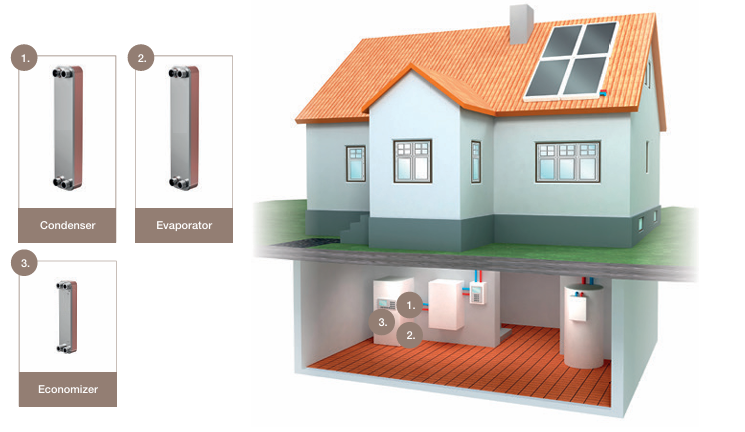
A heat pump moves energy from a lower temperature source to a higher temperature load. The compressor upgrades the temperature level, but the actual absorption and rejection of heat happens in the heat exchangers. Depending on the circuit design, a heat pump may use different exchanger technologies on the refrigerant side and on the water or process side.
Typical Heat Pump Applications for Different Heat Exchanger Technologies
Residential and Light Commercial Heat Pumps
Compact air source and water source heat pumps often use BPHE as condenser, evaporator, economizer, or domestic hot water exchanger because size, efficiency, and compact integration are critical.
CO2 Heat Pumps
Transcritical R744 heat pumps usually require specially designed CO2 BPHE or other high-pressure exchangers for gas cooler duty and water heating applications where operating pressure is much higher than standard systems.
Ammonia and Industrial Refrigerant Systems
Industrial heat pumps using ammonia or other demanding refrigerants often rely on semi-welded plate heat exchangers or plate & shell solutions for better sealing integrity and pressure capability.
High Temperature Industrial Heat Pumps
As industrial heat pumps move into higher delivery temperatures and larger capacities, plate & shell and shell & tube exchangers become increasingly relevant where robustness and pressure resistance are essential.
Geothermal and Water Source Systems
Ground source and water source heat pumps may use BPHE for compact clean-loop duties, while larger or dirtier-water systems may require GPHE, shell & tube, or other serviceable formats depending on fouling risk.
Heat Recovery and Process Integration
Industrial heat recovery systems often apply multiple exchanger types in the same heat pump package, combining compact efficiency with mechanical robustness where process fluids or pressure levels vary.
Best Heat Exchanger Types for Heat Pump Applications
Heat pump systems use a wider range of exchanger technologies than many HVAC applications. The most relevant types are not interchangeable in every case. Each technology has its own best-fit window depending on refrigerant, pressure, cleanliness, duty profile, and service requirements.
BPHE – Brazed Plate Heat Exchangers
BPHE is the most common choice for compact residential and commercial heat pumps. It is widely used as condenser, evaporator, economizer, desuperheater, and water heating exchanger in systems using standard refrigerants where compactness and high efficiency are critical.
CO2 BPHE
CO2 BPHE is designed for transcritical R744 heat pump applications, especially gas cooler duty and high-pressure water heating systems. It is a key solution for commercial CO2 heat pumps, sanitary hot water production, and energy-efficient hot water generation where high operating pressure is a defining factor.
Semi-Welded Plate Heat Exchangers
Semi-welded plate heat exchangers are well suited for ammonia heat pumps and industrial refrigerant systems where stronger sealing reliability is required together with efficient plate heat transfer. They are often selected when one side involves refrigerant service and the other side remains openable or more serviceable.
Plate & Shell Heat Exchangers
Plate & shell heat exchangers are often selected for industrial heat pumps, higher-pressure applications, and demanding duties where a more robust vessel construction is preferred while maintaining plate-type thermal efficiency. They can be a strong choice for condensers and evaporators in larger industrial packages.
Shell & Tube Heat Exchangers
Shell & tube heat exchangers remain a practical and often conservative option for larger heat pump systems, dirtier water conditions, open-loop water source systems, seawater or groundwater duties, and installations where mechanical cleaning access and traditional plant design are priorities.
Heat Pump Heat Exchanger Comparison by Application Logic
| Heat Exchanger Type | Best Fit | Main Advantages | Typical Heat Pump Use |
|---|---|---|---|
| BPHE | Compact standard refrigerant systems | High efficiency, very compact, strong thermal performance | Residential and commercial condensers, evaporators, economizers, DHW modules |
| CO2 BPHE | Transcritical R744 systems | Designed for high pressure and gas cooler duty | CO2 heat pumps, hot water generation, sanitary water heating |
| Semi-Welded PHE | Ammonia and higher-integrity refrigerant duty | Good thermal efficiency with stronger sealing concept | Industrial ammonia heat pumps, refrigerant-side exchanger duties |
| Plate & Shell | Industrial and higher-pressure applications | Pressure vessel robustness with plate-type efficiency | Industrial condensers, evaporators, high-temperature heat pump packages |
| Shell & Tube | Dirty water, large flow, traditional plant design | Mechanical cleaning, conservative layout, durability in difficult water service | Open-loop water source heat pumps, industrial plant systems, large-capacity units |
Why Plate-Based Solutions Are So Important in Heat Pumps
- Higher heat transfer efficiency than bulkier alternatives in many clean-duty applications.
- Compact footprint, especially valuable in packaged heat pump units.
- Low internal volume that can help support compact system design.
- Strong fit for refrigerant-to-water and water-to-water transfer.
- Fast thermal response under varying load conditions.
- Available in multiple formats for very different pressure and refrigerant requirements.
- Can cover standard refrigerants, CO2, ammonia, and industrial heat recovery duties.
- Supports efficient domestic hot water generation and hydronic heating.
- Offers a scalable path from compact residential systems to industrial projects.
- Plate & shell and semi-welded designs bridge the gap between compact BPHE and conventional shell & tube.
Key Design Considerations for Heat Pump Heat Exchanger Selection
| Design Factor | Why It Matters | Typical Impact on Selection |
|---|---|---|
| Refrigerant Type | Standard refrigerants, CO2, and ammonia create very different pressure and sealing requirements. | Strongly influences whether BPHE, CO2 BPHE, semi-welded, plate & shell, or shell & tube is appropriate. |
| Duty Type | Condenser, evaporator, gas cooler, desuperheater, and economizer duties are not identical. | May require different exchanger styles even within the same heat pump package. |
| Operating Pressure | CO2 and some industrial duties operate at much higher pressure than standard heat pumps. | Limits the exchanger technologies that can safely and economically be used. |
| Source and Load Temperature | Approach temperature targets and source temperature swing affect system efficiency. | Determines thermal sizing, plate pattern, and exchanger area. |
| Water Quality / Fouling | Dirty, scaling, or open-loop water service can degrade performance over time. | May favor shell & tube or more serviceable exchanger configurations. |
| Maintenance Strategy | Some systems are designed as compact sealed modules, others need cleaning access. | Strongly influences exchanger choice and lifecycle suitability. |
| System Scale | Small packaged units and large industrial plants have very different priorities. | Compact BPHE may be ideal in one case while plate & shell or shell & tube is better in another. |
Best Fit by Heat Pump Category
Residential / Light Commercial Heat Pumps
- BPHE is usually the primary choice.
- Compact packaged units benefit from small footprint and high efficiency.
- Common duties: condenser, evaporator, DHW module, economizer.
- Best where fluids are clean and maintenance access is limited.
CO2 Heat Pumps
- CO2 BPHE is often a key choice for gas cooler service.
- High operating pressure must be considered from the start.
- Frequently used in hot water generation and commercial systems.
- Selection is fundamentally different from standard refrigerant heat pumps.
Industrial Ammonia Heat Pumps
- Semi-welded PHE is often highly relevant.
- Higher sealing integrity is important on refrigerant duty.
- Can also involve plate & shell depending on pressure and duty.
- Typical in heat recovery and process heating projects.
High Temperature Industrial Heat Pumps
- Plate & shell becomes more attractive in demanding industrial duties.
- Pressure vessel style construction can be a major advantage.
- Shell & tube may remain preferred in conservative plant layouts.
- Application depends heavily on pressure, fluid quality, and maintainability.
Pressure, Water Quality, and Material Considerations
Heat pump exchanger selection is strongly linked to both refrigerant-side and fluid-side conditions. CO2 systems are primarily defined by pressure. Ammonia systems place greater emphasis on refrigerant containment and exchanger integrity. Water source and geothermal systems often shift the focus toward fouling, scaling, solids, or corrosion. In industrial heat recovery, process-side contamination and cleaning strategy can become just as important as thermal duty.
That is why a technically correct heat pump exchanger decision must combine thermal performance with pressure design, material compatibility, fouling risk, and lifecycle maintenance planning. The best unit is not necessarily the smallest or cheapest one; it is the exchanger that matches the full application reality.
Related Heat Exchanger Knowledge and Product Pages
Heat pump systems are closely connected to broader applications in hydronic heating, hot water generation, industrial heat recovery, and district energy integration. For related technologies and adjacent topics, you can also explore Brazed Plate Heat Exchangers, Gasketed Plate Heat Exchangers, Spiral Heat Exchangers, Heat Recovery Systems, District Heating / Cooling, Renewable Energy, Energy Storage Cooling, and Power Generation.
FAQ: Heat Pump Heat Exchangers
What heat exchanger is best for a heat pump?
Is BPHE always the best choice for heat pumps?
What is the difference between a standard BPHE and a CO2 BPHE?
When should a semi-welded plate heat exchanger be used in a heat pump?
Why choose plate & shell instead of shell & tube in industrial heat pumps?
When is shell & tube still a good choice for heat pump systems?
Conclusion: Heat Pump Applications Require More Than One Heat Exchanger Technology
Heat pumps are not a one-technology market. Standard residential and commercial systems often rely on BPHE, but the broader heat pump landscape also includes CO2 BPHE for transcritical R744 systems, semi-welded plate heat exchangers for ammonia and industrial duties, plate & shell units for robust high-performance applications, and shell & tube exchangers for large, conservative, or dirtier-water systems.
The correct engineering approach is to match the exchanger type to the real application, including refrigerant, pressure, duty type, water quality, maintenance strategy, and project scale. That is the most reliable path to better performance, longer service life, and a technically sound heat pump system design.


