HEXNOVAS • APPLICATION PAGESwimming Pool Heating and Heat Exchanger Solutions
Reliable pool heating solutions using shell & tube and plate heat exchangers for freshwater, saltwater, and seawater applications.
Swimming pool heating systems require durable, corrosion-resistant, and easy-to-maintain heat exchangers to ensure stable temperature control and long service life. Whether the heating source is a boiler, heat pump, solar loop, or district hot water, the heat exchanger acts as the transfer barrier between the primary energy circuit and the pool water. For most demanding pool environments, especially saltwater and seawater conditions, a dedicated swimming pool shell & tube heat exchanger offers strong reliability and material flexibility. In some clean freshwater systems, gasketed plate heat exchangers can also be considered.
Swimming Pool Heating Pool Heat Exchanger Shell & Tube Pool HEX Saltwater Pool Seawater Pool Titanium Heat Exchanger
How Swimming Pool Heating Systems Work
In most pool heating systems, the heat source and the pool water should not mix directly. Instead, heat is transferred indirectly through a heat exchanger.
A typical pool heating arrangement includes a primary side carrying hot water from a boiler, heat pump, solar system, or other heating equipment, and a secondary side carrying the pool water. The heat exchanger transfers energy from the primary side into the circulating pool water while keeping both circuits isolated.
This design improves safety, protects the heating source from pool chemicals, and allows more stable temperature control. It is widely used in residential pools, hotel pools, wellness facilities, therapy pools, spa systems, and commercial aquatic installations.
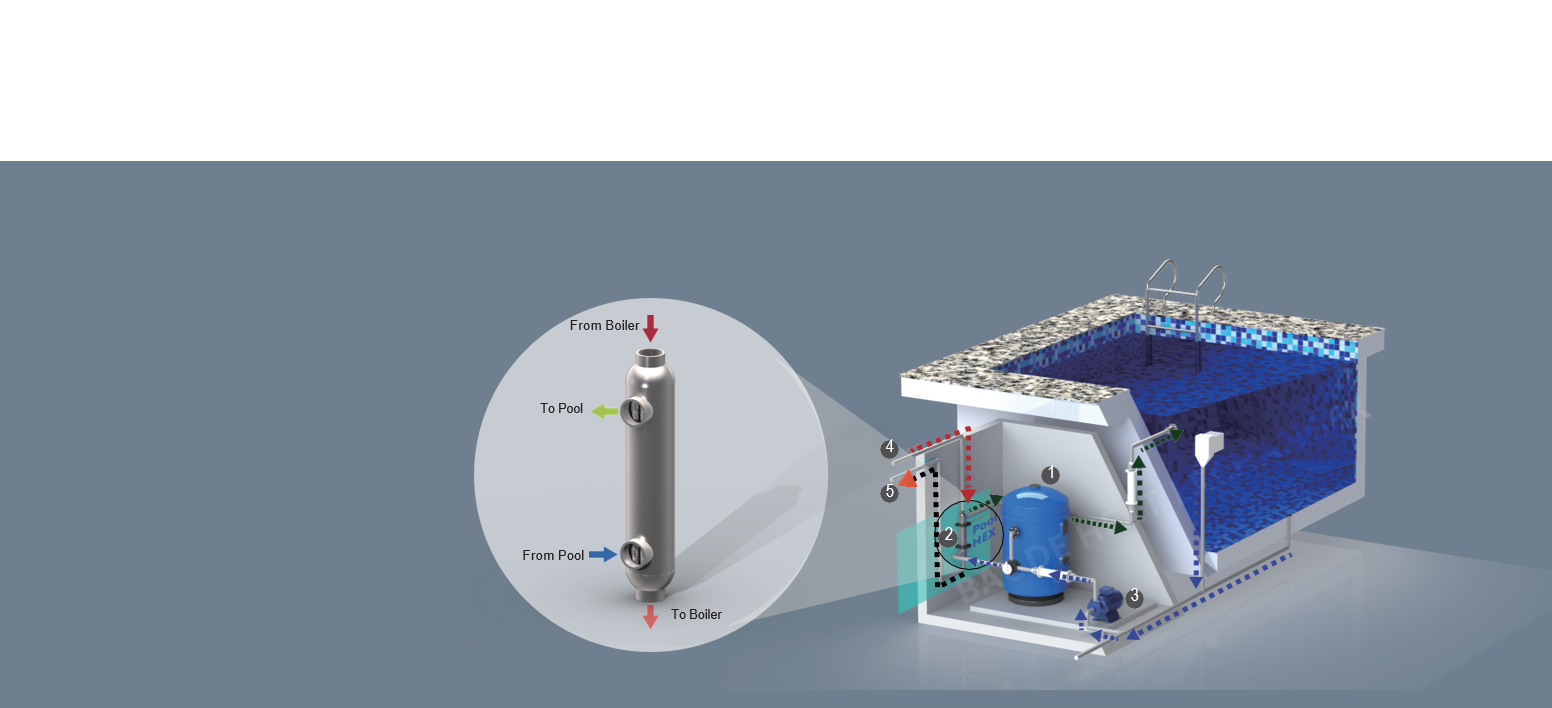
Typical swimming pool heating system layout: the primary hot water loop transfers energy through a dedicated pool heat exchanger to the secondary circulating pool water loop.
Typical Heating Path
- Boiler / Heat Pump / Solar Loop
- Primary hot water circuit
- Pool heat exchanger
- Secondary pool water circuit
- Stable swimming pool temperature control
Shell & Tube vs Plate Heat Exchanger for Swimming Pools
The two most common heat exchanger options for pool heating are shell & tube heat exchangers and gasketed plate heat exchangers (GPHE). While both can transfer heat effectively, the right choice depends heavily on water quality, maintenance expectations, corrosion risk, and installation conditions.
MAIN RECOMMENDATIONSwimming Pool Shell & Tube Heat Exchanger
For many real-world pool systems, especially where reliability and corrosion resistance matter more than compactness, a dedicated shell & tube pool heat exchanger is the stronger choice.
- Better tolerance to poor water quality and system impurities
- More suitable for saltwater and seawater pools
- Flexible material options such as titanium and CuNi
- Lower fouling sensitivity in many harsh service conditions
- Robust mechanical structure and long service life
- Simpler maintenance philosophy for demanding pool environments
OPTIONAL FOR CLEAN SYSTEMSGasketed Plate Heat Exchanger (GPHE)
A GPHE can be used in selected pool heating systems where the water is clean, filtration is good, and compact size is a higher priority.
- Higher thermal efficiency in a compact footprint
- Good for controlled freshwater systems
- Easy capacity adjustment by changing plate count
- However, more sensitive to fouling and water cleanliness
- Gaskets require maintenance over time
- Usually less preferred for harsher salt or seawater duty
Key point: for swimming pool applications, the decision is not based on thermal efficiency alone. Water chemistry, corrosion resistance, maintenance burden, and long-term reliability are often more important. That is why shell & tube pool heat exchangers are frequently the preferred solution in more demanding installations.
Why Shell & Tube Pool Heat Exchangers Are Often the Better Choice
1. Stronger Corrosion Strategy
Pool water can contain chlorine, salts, treatment chemicals, and fluctuating water quality. Shell & tube designs support robust material combinations such as titanium, stainless steel, and copper-nickel, making them highly adaptable to different pool media.
2. Better for Saltwater and Seawater
Saltwater pools and seawater installations can quickly damage incorrectly selected materials. A properly designed shell & tube heat exchanger with titanium or CuNi construction offers much better long-term performance.
3. More Forgiving in Real Operating Conditions
In practical installations, water may not always be perfectly filtered or chemically balanced. Shell & tube pool heat exchangers are often more tolerant of these variations than plate heat exchangers.
4. Long Service Life and Reliable Operation
A simple and robust mechanical structure, combined with suitable material selection, makes shell & tube units attractive for continuous pool heating duty in residential, commercial, and marine environments.
Material Selection for Freshwater, Saltwater, and Seawater Pools
Material selection is one of the most important factors in swimming pool heat exchanger design. The wrong material can lead to rapid corrosion, leakage, expensive maintenance, and early failure.
| Pool Water Type | Typical Material Option | Selection Notes | General Recommendation |
|---|
| Freshwater pool | 304 / 316L stainless steel | Suitable for treated clean water under controlled chemistry | Economical and common for standard freshwater systems |
| Saltwater pool | Titanium / CuNi | Better resistance to chlorides and salt-related corrosion | Titanium is generally the safest long-term choice |
| Seawater pool | Titanium / CuNi 90/10 or 70/30 | Requires high corrosion resistance and careful compatibility review | Titanium is strongly recommended for severe seawater duty |
| Spa / wellness pool | 316L / Titanium | Depends on treatment chemicals, chloride level, and temperature | Check actual water chemistry before final selection |
Warning: chloride-containing water, saltwater systems, and marine environments should never be treated as standard freshwater service. Material selection must consider corrosion risk, disinfectant chemistry, temperature, and expected operating life.
Saltwater and Seawater Pool Heating Considerations
Saltwater and seawater pools present a much more demanding environment than standard freshwater pools. Chlorides and dissolved salts can attack unsuitable materials rapidly, especially when temperatures rise and water chemistry fluctuates.
In these applications, titanium swimming pool heat exchangers are often the preferred solution because of their excellent corrosion resistance. Copper-nickel materials can also be considered in some systems, depending on the specific water quality and economic target.
For this reason, shell & tube pool heat exchangers are especially attractive in salt and marine-duty projects, because they allow durable tube-side material selection and strong long-term reliability.
Best-Fit Applications
- Saltwater swimming pools
- Seawater swimming pools
- Hotel and resort pools
- Marine leisure facilities
- Spa and wellness systems with aggressive water chemistry
Typical Swimming Pool Heating Applications
Residential Pools
Stable and efficient pool heating for villas, private homes, and backyard pools using boilers or heat pumps.
Commercial Pools
Reliable heating for hotels, sports centers, public pools, and year-round aquatic facilities.
Spa and Wellness Pools
Controlled water temperature for spa pools, therapy pools, and wellness systems with chemical treatment considerations.
Saltwater and Marine Pools
Corrosion-resistant solutions for pools using saltwater treatment systems or direct seawater service.
How to Select the Right Pool Heat Exchanger
The right swimming pool heat exchanger should be selected based on the actual operating conditions, not only on thermal duty. A robust selection process should review:
- Water type: freshwater, saltwater, seawater, or chemically treated spa water
- Heating source: boiler, heat pump, solar, or district hot water
- Flow rate and temperature target: required pool heating capacity
- Material compatibility: corrosion resistance under actual water chemistry
- Maintenance preference: compact high-efficiency vs robust long-life design
- Installation environment: residential indoor pool, outdoor pool, commercial facility, or marine project
In many cases, a shell & tube pool heat exchanger is selected not because it is the smallest option, but because it is the most durable and reliable one for long-term swimming pool service.
FAQ
What is the best heat exchanger for a saltwater pool?
In most cases, a titanium shell & tube heat exchanger is the most reliable choice for saltwater pool heating because of its strong corrosion resistance and long-term durability.
Can a plate heat exchanger be used for swimming pools?
Yes, but it is usually better suited to clean freshwater pool systems with good filtration and controlled water chemistry. It is generally less forgiving in harsh salt or seawater conditions.
Why is titanium used in pool heat exchangers?
Titanium offers excellent resistance to chloride and salt corrosion, which makes it one of the best materials for saltwater pools, seawater pools, and aggressive pool treatment environments.
Which is better for pool heating: shell & tube or plate heat exchanger?
It depends on the water quality and operating conditions. For harsh environments and long-term reliability, shell & tube heat exchangers are often better. For clean systems where compactness is important, plate heat exchangers can be considered.
Can the same pool heat exchanger be used for freshwater and seawater?
Not necessarily. Seawater duty usually requires much more corrosion-resistant materials, especially titanium or selected CuNi alloys. The material must be matched to the actual water chemistry.