Definition
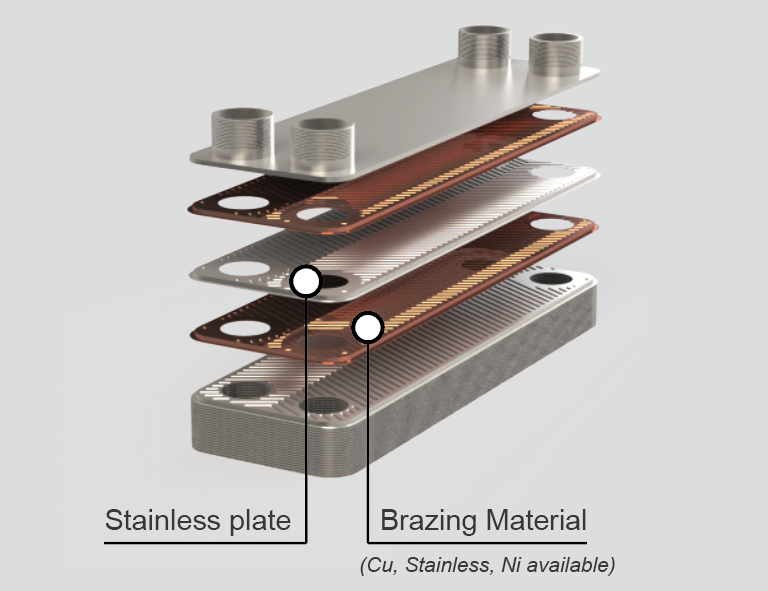
Unlike shell-and-tube exchangers, a BPHE uses multiple corrugated plates stacked into alternating flow channels.
The plates are brazed in a vacuum furnace, creating a single sealed block with excellent thermal performance and reliability.
Working Principle
- Two fluids flow through alternating channels between corrugated plates.
- Heat transfers through thin stainless steel walls without fluid mixing.
- Corrugations generate turbulence, increasing heat transfer coefficients.
A gasketed plate heat exchanger (GPHE) uses elastomer gaskets between plates, allowing disassembly for mechanical cleaning.
A brazed plate heat exchanger is permanently sealed (no gaskets), typically offering a more compact footprint and higher leakage security.
Why Choose a Brazed Plate Heat Exchanger?
- High heat transfer efficiency in a compact volume
- Space-saving and lightweight for skids and retrofits
- No gasket leakage risk (gasket-free construction)
- Lower maintenance and reduced downtime
Core Features of Modern BPHE Designs
- Advanced plate geometry for high turbulence and heat transfer
- Stainless steel plates + copper/nickel brazing materials
- Wide compatibility across HVAC, refrigeration, and industrial duties
- Compact footprint for tight installation spaces
Where Brazed Plate Heat Exchangers Are Used
| Industry / System | Typical BPHE Use |
|---|
| HVAC & Building Services | Hydronic heating/cooling, chillers, heat pumps, district energy interfaces |
| Refrigeration & Cold Storage | Evaporators/condensers, oil coolers, subcoolers for stable temperature control |
| Industrial Processing | Food & beverage, chemical processing, manufacturing heat recovery |
| Marine & Transportation | Engine cooling, HVAC on vehicles, waste heat recovery |
Comparison: Brazed Plate vs GPHE
- BPHE is permanently sealed; GPHE can be opened for mechanical cleaning.
- BPHE typically offers smaller footprint; GPHE is preferred where frequent cleaning is required.
- BPHE reduces gasket-related leakage risks; GPHE requires gasket inspection/replacement over time.
Conclusion
A brazed plate heat exchanger delivers strong thermal performance, compactness, and reliability—ideal for energy-efficient
HVAC, refrigeration, and many industrial heat transfer applications.
FAQ – Brazed Plate Heat Exchangers
1) How does a brazed plate heat exchanger work?
Two fluids flow through alternating channels formed by corrugated stainless steel plates. The plates are brazed (copper or nickel) to create sealed paths.
Heat transfers through the thin plates without fluid mixing.
2) What is the difference between BPHE and a gasketed plate heat exchanger (GPHE)?
BPHEs are permanently sealed and gasket-free—compact, pressure-resistant, and low maintenance. GPHEs can be opened for mechanical cleaning but require more
space and periodic gasket replacement.
3) What fluids can be used in a brazed plate heat exchanger?
Water, glycol mixtures, many refrigerants (R134a, R410A, CO₂), hydraulic oils, and light industrial fluids. Copper-brazed units are typically not recommended
for ammonia; nickel-brazed or fully stainless options are preferred for aggressive media.
4) What are typical pressure and temperature limits?
Limits depend on design and materials. Many BPHE designs are rated up to 30–45 bar and up to ~200°C (model-dependent). Always verify the exact model rating.
5) Can brazed plate heat exchangers be cleaned?
BPHEs cannot be mechanically opened, but they can be cleaned using chemical CIP and flushing. Proper filtration and water treatment greatly reduce fouling.