In some gasketed plate heat exchanger (GPHE) applications equipped with Viton (FKM) gaskets, a minor and temporary leakage may be observed at the circular gasket area between the head plate and the first one or two plates during start-up.
This phenomenon is typically transient, occurs only during the initial heating phase, and does not indicate a defect in the gasket material or plate quality.
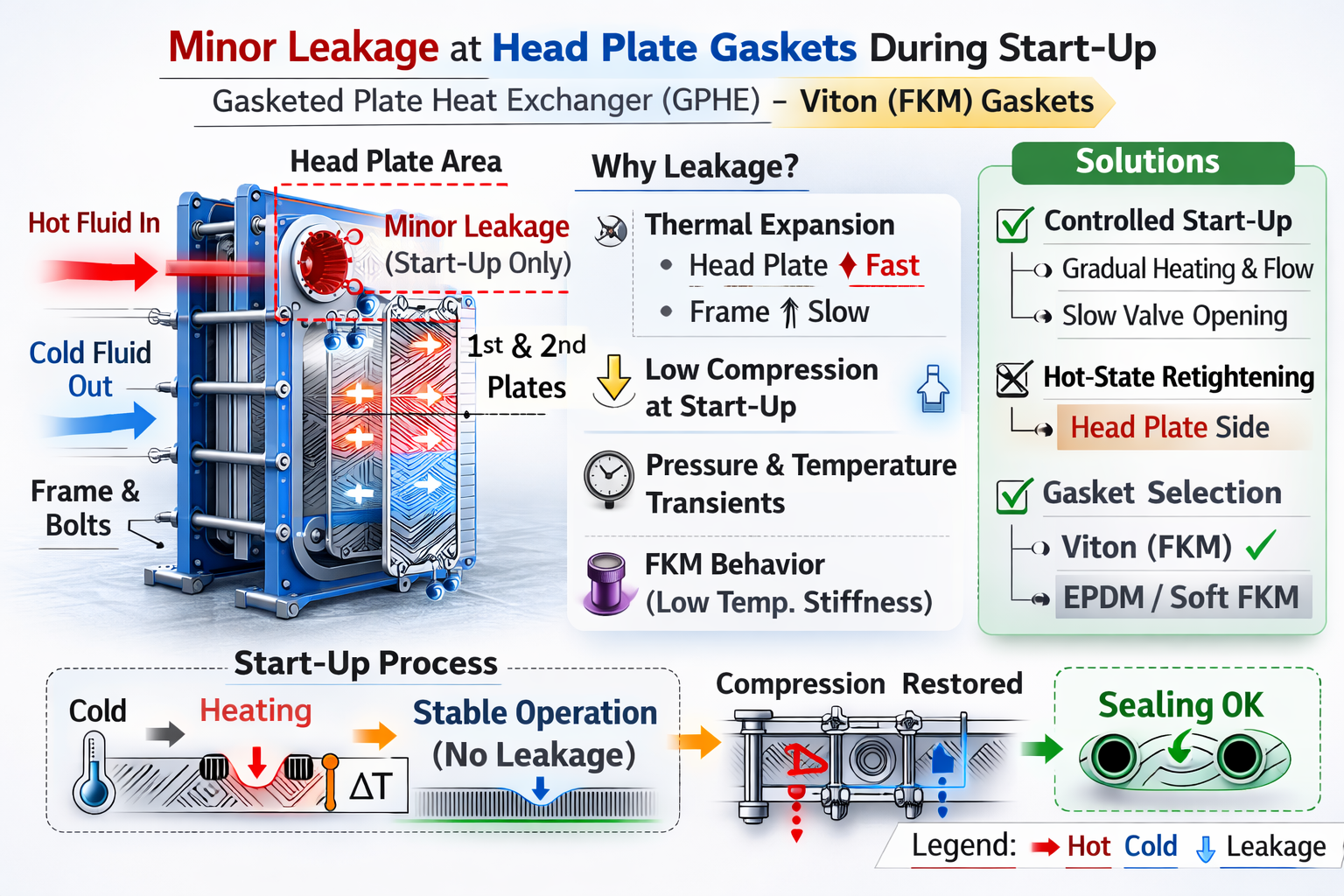
Leakage appears only during start-up
Leakage is usually limited to small droplets or slight seepage
The location is typically:
Head plate
First or second plate circular (port) gasket area
Leakage often stops automatically once operating conditions stabilize
During start-up, the hot medium enters the head plate section first. This causes:
Rapid thermal expansion of the head plate and the first plates
Slower temperature rise of the frame, tightening bolts, and tie bars
As a result, the effective gasket compression at the head plate area is temporarily reduced, which may allow minor leakage until thermal equilibrium is reached.
From a structural standpoint:
The head plate area experiences the lowest and least uniform clamping force
The first one or two plates are the most sensitive to small changes in compression
Therefore, any short-term loss of effective tightening force will appear first at the head plate gaskets.
Viton (FKM) gaskets provide excellent resistance to high temperatures, oils, and aggressive media. However:
At lower temperatures, FKM exhibits higher hardness and slower elastic recovery
During rapid temperature changes, FKM gaskets may respond less flexibly than EPDM or NBR
This material behavior can contribute to temporary micro-leakage during start-up, especially in high-temperature or rapid-heating applications.
Rapid valve opening or sudden pump start-up can generate:
Short-term pressure spikes
Differential pressure fluctuations across the plates
These transient loads may momentarily disturb the gasket sealing line at the most sensitive location — the head plate ports.
This phenomenon:
❌ Is not caused by gasket damage
❌ Is not caused by plate cracking
❌ Does not indicate internal leakage between media
It is a start-up related sealing behavior and is generally considered a normal operational characteristic under certain conditions.
Gradually increase flow and temperature
Avoid rapid valve opening or sudden pump start-up
Allow the unit to warm up progressively
After reaching stable operating temperature, inspect the unit
If necessary, apply minor, uniform tightening, prioritizing the head plate side
Always remain within the manufacturer’s specified tightening limits
For applications with frequent cold start-ups or large temperature gradients:
Consider alternative gasket materials if compatible with the media
Or select softer or application-optimized FKM grades
Minor leakage at the head plate gasket area during start-up of GPHEs equipped with Viton gaskets is a well-understood and manageable phenomenon.
With proper start-up procedures and correct mechanical adjustment, reliable long-term sealing performance can be fully ensured.
No.
Minor leakage during start-up is typically a transient sealing behavior caused by thermal expansion differences and temporary compression variation. It does not indicate gasket failure or plate damage.
The head plate and the first one or two plates experience:
The fastest temperature rise during start-up
The most sensitive compression conditions
The least uniform clamping force
Therefore, any temporary reduction in effective gasket compression appears first at this location.
No.
If the leakage stops after thermal stabilization and no further seepage occurs under steady conditions, the gasket is functioning normally.
Permanent leakage under stable conditions would require inspection.
FKM gaskets:
Have higher hardness at low temperatures
Exhibit slower elastic recovery during rapid heating
Require stable compression to fully seal
During rapid temperature transitions, this behavior can allow temporary micro-seepage.
No.
Start-up seepage at the port gasket area is external only and does not imply internal cross-contamination between the two media circuits.
It is less common but still possible.
EPDM and NBR generally have softer low-temperature elasticity, making them slightly more forgiving during cold start-ups. However, system design and compression settings remain the dominant factors.
Recommended measures:
Gradual heating during start-up
Slow valve opening
Controlled pump ramp-up
Hot-state inspection and uniform retightening within torque limits
Avoid sudden temperature or pressure spikes.
Only after reaching operating temperature.
If leakage persists under stable hot conditions, minor and uniform tightening may be applied on the head plate side — always within manufacturer specifications.
Never overtighten during cold conditions.
Gasket replacement is only necessary if:
Leakage continues under stable operating conditions
Visible gasket damage or extrusion is present
Aging, chemical attack, or hardening is confirmed
Temporary start-up seepage alone does not justify replacement.
Yes.
It is more likely in:
High-temperature systems
Units with large temperature gradients
Systems with rapid thermal cycling
Frequent cold start-ups
With proper procedures, it remains fully manageable.
No, provided that:
Start-up procedures are controlled
Compression is within design limits
Operating conditions stabilize normally
The long-term sealing performance remains reliable.