
Heat Exchangers in Data Centers
Modern data centers are energy systems — heat exchangers are the core thermal interface.
数据中心中的换热器
现代数据中心已成为综合能源系统——换热器是其关键热接口。
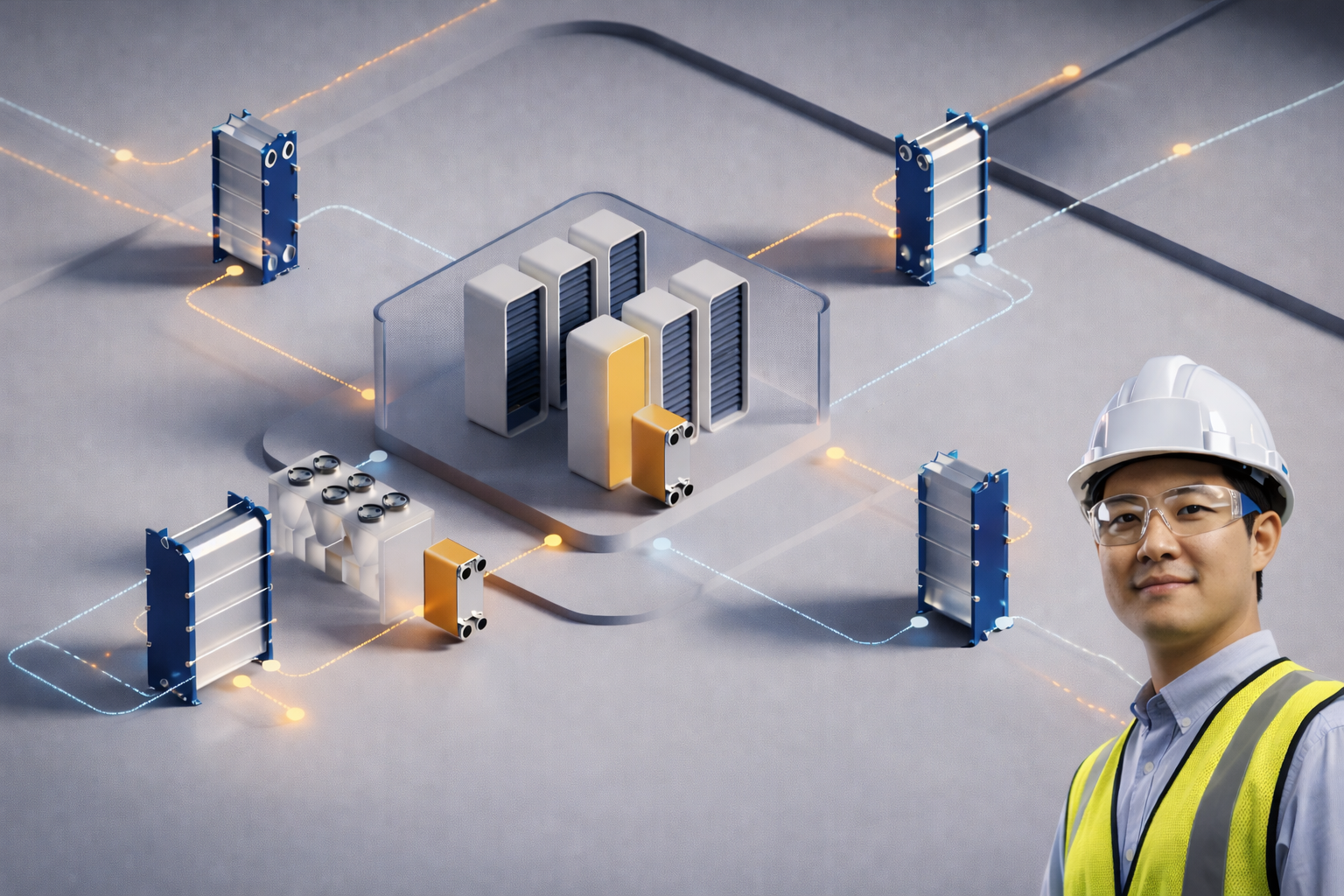 System diagram — Heat exchangers as thermal bridges.
系统示意图——换热器作为“热桥”连接各环节。
Modern data centers are no longer simple server rooms. They are complex energy systems integrating cooling, power management, and waste heat recovery. As shown in the system diagram, heat exchangers form the core thermal interface between IT equipment and external energy infrastructure.
现代数据中心早已不是简单的机房,而是集成冷却、电力管理与余热回收的复杂能源系统。 如图所示,换热器构成 IT 设备与外部能源基础设施之间的核心热接口。
Rather than acting as isolated components, heat exchangers operate as thermal bridges, connecting internal liquid cooling loops with facility water systems, free cooling units, and heat reuse networks.
换热器并非孤立部件,而是“热桥”——将内部液冷回路与机房水系统、自然冷却单元以及热量再利用网络连接起来。
1. Cooling System – BPHE (Brazed Plate Heat Exchanger) Inside CDU
1. 冷却系统——CDU 内的钎焊板式换热器(BPHE)
In the cooling section, heat exchangers are located inside the Coolant Distribution Unit (CDU). The BPHE separates two independent circuits:
在冷却部分,换热器通常集成在冷却液分配单元(CDU)内。BPHE 将两个相互独立的回路隔离开:
- IT coolant loop (directly connected to servers)
- Facility water loop (chilled water or cooling water)
- IT 冷却液回路(直接连接服务器)
- 机房/楼宇水回路(冷冻水或冷却水)
The BPHE transfers heat from server liquid to building water without mixing fluids.
BPHE 在不混合介质的前提下,将服务器液体回路的热量传递至楼宇水系统。
Typical parameters
典型参数
- IT loop inlet: 30–45°C
- IT loop outlet: 20–30°C
- Cooling capacity per BPHE: 200–1500 kW
- Design pressure: 10–25 bar
- Approach temperature: 2–4 K
- IT 回路入口温度:30–45°C
- IT 回路出口温度:20–30°C
- 单台 BPHE 制冷量:200–1500 kW
- 设计压力:10–25 bar
- 端温差(Approach):2–4 K
Here, the heat exchanger ensures stable server operation, electrical isolation, and high heat transfer efficiency in a compact space.
在此环节,换热器保障:服务器运行稳定、电气隔离可靠,并在紧凑空间内实现高效换热。
2. Free Cooling – Heat Exchanger as Environmental Interface
2. 自然冷却——换热器作为环境接口
In the free cooling section, heat exchangers connect internal cooling loops to dry coolers, cooling towers, or ambient water sources. Instead of using chillers, the system uses outside air or water directly.
在自然冷却环节,换热器将内部冷却回路与干冷器、冷却塔或环境水源相连。 系统尽量不依赖冷水机组,而是直接利用室外空气或水源进行换热。
Typical operation
典型运行范围
- Cold water temperature: 12–18°C
- Free cooling window: 40–70% of annual operating hours
- Energy savings: 15–30%
- 冷却水温度:12–18°C
- 自然冷却窗口:全年运行小时的 40–70%
- 节能幅度:15–30%
In this scenario, the heat exchanger becomes the boundary between the data center and the natural environment.
在该场景下,换热器成为数据中心与自然环境之间的“边界接口”。
3. Waste Heat Recovery – Heat Exchanger as Energy Export Device
3. 余热回收——换热器作为“能量输出设备”
The lower part of the diagram shows how heat exchangers enable waste heat reuse. Recovered warm water is transferred to office buildings, district heating systems, or domestic hot water networks.
示意图下半部分展示了换热器如何实现余热再利用。 回收的温水可输送至办公楼、区域供热系统或生活热水网络。
Typical heat recovery parameters
典型余热回收参数
- Warm water temperature: 30–55°C
- Annual reuse time: 6000–8000 hours
- CO₂ reduction: up to 40%
- 温水温度:30–55°C
- 年可再利用时间:6000–8000 小时
- CO₂ 减排:最高可达 40%
In this role, the heat exchanger transforms the data center from a pure energy consumer into an energy supplier.
在该角色下,换热器使数据中心从单纯“耗能者”转变为“供能者”。
Engineering Conclusion
工程结论
From cooling to free cooling and heat recovery, heat exchangers are no longer auxiliary devices. They act as:
从常规冷却到自然冷却再到余热回收,换热器已不再是辅助设备,而是承担以下核心角色:
- Thermal interfaces
- Energy transfer hubs
- System integration components
- 热接口(Thermal interfaces)
- 能量传递枢纽(Energy transfer hubs)
- 系统集成关键部件(System integration components)
In next-generation data centers, heat exchangers are not just part of the cooling system — they are core infrastructure for digital energy management.
在下一代数据中心中,换热器不仅属于冷却系统的一部分,更是“数字能源管理”的核心基础设施。
FAQ – Heat Exchangers in Data Centers
FAQ——数据中心换热器常见问题
1) What type of heat exchanger is typically used inside a CDU? CDU 里通常用什么换热器?
Inside a Coolant Distribution Unit (CDU), the most commonly used type is a Brazed Plate Heat Exchanger (BPHE).
在 CDU(冷却液分配单元)内部,最常用的是钎焊板式换热器(BPHE)。
Reasons:
- Compact size for rack-level or room-level integration
- High heat transfer coefficient
- Low approach temperature (2–4 K)
- High pressure capability (10–25 bar typical)
- No gasket leakage risk
原因:
- 体积紧凑,易于机架级/房间级集成
- 传热系数高
- 端温差低(2–4 K)
- 耐压能力强(典型 10–25 bar)
- 无胶垫泄漏风险
For higher capacities (above ~1.5 MW), gasketed plate heat exchangers (GPHE) or plate-and-shell heat exchangers (PSHE) may be used.
当容量更高(约超过 1.5 MW)时,可能选用可拆式板换(GPHE)或板壳式换热器(PSHE)。
2) When should a gasketed plate heat exchanger be used? 何时应选 GPHE?
A Gasketed Plate Heat Exchanger (GPHE) is typically used when:
- Cooling capacity exceeds 1–2 MW
- Maintenance accessibility is required
- Water quality may require mechanical cleaning
- Long-term serviceability is critical
GPHE 通常适用于以下情况:
- 冷却量超过 1–2 MW
- 需要便于维护检修
- 水质因素要求可机械清洗
- 强调长期可维护性与可服务性
GPHE units allow plate removal and cleaning, making them suitable for large central plant installations.
GPHE 可拆卸板片并进行清洗,适合大型中央机房/冷站的工程应用。
3) Are shell-and-tube heat exchangers used in data centers? 数据中心用管壳式吗?
Yes, but less frequently. They are used when:
- Extremely high reliability is required
- Water quality is poor
- Fouling risk is high
- Very large flow rates exist
会用,但相对少见。常见于:
- 对可靠性要求极高
- 水质较差
- 结垢/污堵风险高
- 流量非常大
However, they typically have a larger footprint, lower efficiency vs plates, and higher approach temperatures.
但其通常占地更大、传热效率低于板式方案、端温差更高。
For modern high-density data centers, plate heat exchangers are generally preferred.
对现代高密度数据中心而言,板式换热器通常更受青睐。
4) What type is best for free cooling systems? 自然冷却用哪种最好?
Common options:
- GPHE – most common for building-side integration
- BPHE – for modular or smaller systems
- Welded Plate – for higher pressure or glycol concentration
常见选择:
- GPHE——楼宇侧集成最常见
- BPHE——模块化或小型系统
- 全焊板式——更高压力或更高乙二醇浓度
Selection depends on water chemistry, maintenance strategy, approach temperature, and capacity.
选型取决于水质/化学特性、维护策略、端温差要求与容量范围。
5) What type is used for waste heat recovery? 余热回收用哪种?
- GPHE / PSHE for district heating integration
- Plate-and-Shell for higher pressure networks
- Double-wall exchangers when separation safety is required
- GPHE / PSHE——用于区域供热对接
- 板壳式——适用于更高压力管网
- 双壁换热器——当需要更高介质隔离安全时
When exporting heat to district heating systems, design pressures can exceed 16–25 bar, requiring reinforced plate or welded structures.
当余热输出到区域供热系统时,设计压力可能超过 16–25 bar,需要加强板片或采用焊接结构。
6) Why are plate heat exchangers preferred? 为什么板换更常用?
- Very high heat transfer efficiency
- Low approach temperature (critical for liquid cooling)
- Compact footprint
- Modular scalability
- Lower refrigerant/coolant charge
- Easier integration with energy recovery systems
- 传热效率高
- 端温差低(液冷场景非常关键)
- 占地小
- 模块化、易扩展
- 冷媒/冷却液充注量更低
- 更易与余热回收系统集成
7) What materials are typically used? 常用材料有哪些?
Plates: 316L (most common), 304 (low corrosion), Titanium (special water)
板片:316L(最常见)、304(低腐蚀环境)、钛(特殊水质)
Brazing: Copper (standard), Nickel (aggressive fluids)
钎料:铜(常规水)、镍(更苛刻介质)
Gaskets (for GPHE): EPDM (water), NBR (oil), FKM (high temperature)
胶垫(GPHE):EPDM(水)、NBR(油)、FKM(高温)
8) How do heat exchangers impact PUE? 对 PUE 有什么影响?
Efficient heat exchanger design reduces chiller load, improves free cooling window, enables higher supply temperatures, and supports waste heat reuse — directly lowering cooling energy consumption and improving PUE.
高效的换热器设计可降低冷机负荷、扩大自然冷却窗口、支持更高供水温度,并促进余热再利用—— 从而直接减少冷却能耗并改善 PUE。
In liquid-cooled data centers, the heat exchanger is one of the primary determinants of thermal efficiency.
在液冷数据中心中,换热器往往是决定整体热效率的关键因素之一。
9) What design factors are most critical? 选型最关键的因素?
- Cooling capacity (kW or MW)
- Approach temperature
- Pressure drop limitations
- Water chemistry
- Maintenance access
- Redundancy requirements
- Future scalability
- 换热量(kW 或 MW)
- 端温差(Approach)
- 允许压降
- 水质/化学特性
- 维护检修空间
- 冗余要求
- 未来扩容与可扩展性
Proper sizing is critical because undersizing increases approach temperature, while oversizing increases capital cost.
合理选型至关重要:选小会导致端温差上升;选大则提高初投资成本。
10) Are double-wall heat exchangers required? 需要双壁吗?
Double-wall heat exchangers may be required when:
- There is risk of cross-contamination
- Fluids must remain absolutely isolated
- Compliance standards demand leak detection
在以下情况下可能要求双壁换热器:
- 存在交叉污染风险
- 介质必须绝对隔离
- 法规/标准要求泄漏检测
They provide enhanced safety but increase cost and footprint.
其安全性更高,但成本与占地通常也会增加。
Pillow Plate Heat Exchangers in Data Centers
数据中心中的枕形板(Pillow Plate)换热器
Are pillow plate heat exchangers used in data centers? Yes — but not typically inside CDUs.
数据中心会用枕形板换热器吗?会——但通常不用于 CDU 内部的主液-液换热。
Pillow plate heat exchangers are more commonly used in:
- Rear door heat exchangers (RDHx)
- Immersion cooling tank walls
- Waste heat recovery modules
- Structural cooling panels
枕形板更常见于:
- 机柜后门换热器(RDHx)
- 浸没式冷却槽体壁面
- 余热回收模块
- 结构化冷却面板
Where Pillow Plates Are Applied
枕形板在数据中心的典型应用位置
1️⃣ Rear Door Heat Exchangers (RDHx)
1️⃣ 机柜后门换热器(RDHx)
Pillow plates can be integrated into server rack rear doors as air-to-water cooling panels.
枕形板可集成在机柜后门,作为“空气-水”冷却面板。
- Large surface area
- Uniform coolant distribution
- Low pressure drop
- Structural rigidity
- 换热面积大
- 冷却液分布均匀
- 压降低
- 结构刚性好
2️⃣ Immersion Cooling Tanks
2️⃣ 浸没式冷却槽
In single-phase immersion systems, pillow plates may be integrated into tank walls or used as internal panels.
在单相浸没系统中,枕形板可作为槽体壁面或内部冷却面板。
- High mechanical strength
- Easy fabrication in large panels
- Good compatibility with dielectric fluids
- Fully welded → highly leak-resistant
- 机械强度高
- 便于做成大尺寸面板
- 与绝缘介质兼容性好
- 全焊结构 → 抗泄漏能力强
3️⃣ Waste Heat Recovery Panels
3️⃣ 余热回收面板
Large pillow plate panels can be installed in heat recovery skids for warm water transfer.
大型枕形板面板可用于余热回收撬装系统,实现温水侧的热量传递。
- Suitable for medium-pressure warm water transfer
- Ideal when large flat heat transfer surfaces are needed
- 适合中等压力温水输送
- 当需要大面积平面换热时优势明显
Why Pillow Plates Are Not Common in CDUs
为什么枕形板在 CDU 中不常见
| Factor | BPHE | Pillow Plate |
|---|---|---|
| Compactness | Very High | Moderate |
| Heat Transfer Coefficient | Very High | Lower |
| Approach Temperature | 2–4 K | Higher |
| Size per kW | Small | Larger |
| Pressure Capability | High | High |
CDU 需要:极紧凑体积、极高换热密度、低端温差。BPHE/GPHE 由于波纹板片与强湍流通道,单位面积换热性能更强; 枕形板通常湍流强度较低,导致单位面积换热能力偏低,因此在 CDU 内部不占主流。
When Pillow Plate Is the Right Choice
枕形板何时是更合适的选择
- Large flat surfaces are available
- Structural integration is required
- Moderate heat flux density is acceptable
- Fully welded construction is preferred
- Fouling tolerance is needed
- 有足够大的平面结构空间
- 需要结构化集成(面板即结构)
- 可接受中等热流密度
- 更偏好全焊结构
- 需要更好的耐污堵能力
Engineering Perspective: In modern high-density AI data centers, BPHE/GPHE dominate CDU applications; pillow plates support rack-level and immersion cooling structures; welded plate or plate-and-shell designs are used for district heating export.
工程视角:在现代高密度 AI 数据中心中,BPHE/GPHE 主导 CDU 场景; 枕形板更多用于机柜级与浸没式冷却结构;而输出到区域供热网络时,常用全焊板式或板壳式等更耐压结构。


