Why Semi-Welded Plate Heat Exchangers Are Used in Ammonia Refrigeration
Ammonia (NH₃) is one of the most efficient and environmentally friendly natural refrigerants. It offers excellent thermodynamic performance, zero global warming potential (GWP), and high energy efficiency. For this reason, ammonia is widely used in industrial refrigeration systems such as cold storage, food processing, chemical plants, and ice rinks.
However, ammonia is also toxic, corrosive to certain materials, and operates under relatively high pressure, which places strict requirements on heat exchanger design.
This is where Semi-Welded Plate Heat Exchangers (SWPHE) become the optimal solution.
In ammonia refrigeration systems, one side of the heat exchanger carries ammonia, while the other side carries water or glycol.
Semi-welded design ensures:
Ammonia channels are fully welded (no gasket contact)
No risk of refrigerant leakage into water system
Maximum operational safety
This is a fundamental requirement in ammonia system engineering.
Ammonia systems typically operate at:
Condenser pressure: 10–18 bar
Evaporator pressure: 2–6 bar
Semi-welded plate heat exchangers can handle:
Design pressures up to 25–30 bar
Repeated pressure fluctuations
Thermal cycling without gasket fatigue
This makes them far more reliable than fully gasketed designs.
Compared with shell-and-tube heat exchangers:
Plate heat exchangers provide 3–5 times higher heat transfer coefficients
Smaller approach temperature (1–3 K)
Lower refrigerant charge
Compact footprint
This directly reduces:
Compressor power consumption
System energy cost
Equipment installation space
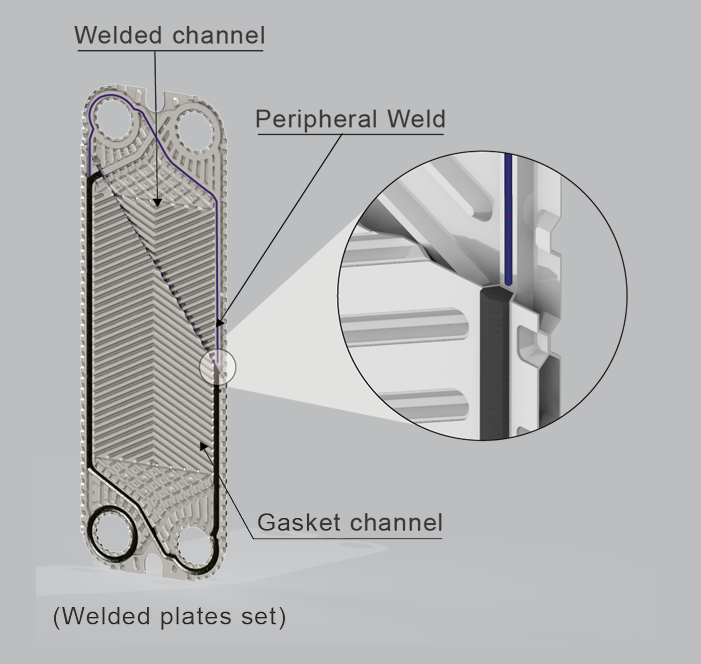
The unique advantage of semi-welded design:
| Side | Structure |
|---|---|
| Ammonia side | Fully welded |
| Water side | Gasketed & removable |
This allows:
Safe isolation of ammonia
Easy mechanical cleaning of water side
No need to open refrigerant circuit during maintenance
Which is extremely important for food and cold storage facilities.
Semi-welded plate heat exchangers typically use:
Stainless steel 316L or 304 for plates
Laser or TIG welded ammonia channels
Special elastomers for water side gaskets
This ensures:
Long-term corrosion resistance
Compliance with food and safety standards
In ammonia refrigeration systems, semi-welded plate heat exchangers provide the ideal balance between:
Safety
Efficiency
Pressure resistance
Maintainability
They combine the thermal performance of plate heat exchangers with the safety of welded structures.
This is why semi-welded plate heat exchangers have become the industry standard solution for industrial ammonia refrigeration.
Ammonia (NH₃) can attack certain gasket materials and poses serious safety risks if leakage occurs.
In fully gasketed plate heat exchangers, both sides rely on elastomer sealing. If gasket degradation happens, ammonia could leak into the water circuit or to atmosphere.
Semi-welded designs eliminate this risk by fully welding the ammonia channels.
Fully welded plate heat exchangers offer high safety, but they are:
More expensive
Difficult to mechanically clean
Less serviceable on fouling water side
Semi-welded plate heat exchangers provide the optimal compromise:
Welded refrigerant side + serviceable water side.
Yes. They are commonly used as:
Flooded ammonia evaporators
Ammonia condensers
Ammonia subcoolers
Cascade intercoolers
Their pressure resistance and safety design make them ideal for these applications.
Typical design pressures range from:
16–25 bar standard
Up to 30 bar or higher depending on manufacturer
They are specifically engineered to handle ammonia pressure fluctuations and thermal cycling.
Yes.
Semi-welded plate heat exchangers typically require significantly lower ammonia charge compared to shell-and-tube designs, which:
Improves safety
Reduces refrigerant inventory
Lowers regulatory burden
This is a major advantage in modern industrial refrigeration plants.
Yes.
The water (or glycol) side is gasketed and removable, allowing:
Mechanical cleaning
Plate inspection
Replacement of gaskets
The ammonia circuit remains sealed during maintenance.
Common materials include:
Stainless steel 316L plates
Laser or TIG welded ammonia channels
NBR or EPDM gaskets (on water side only)
Material selection must comply with pressure and corrosion requirements.
Semi-welded plate heat exchangers typically provide:
3–5 times higher heat transfer coefficients
Smaller approach temperature (1–3 K)
More compact installation
This results in improved COP and lower compressor power consumption.
No. pressure can not reach high pressure. have to choose Utra high pressure plate heat exchanger
Because they provide the optimal balance between:
Maximum safety (welded ammonia channels)
High thermal efficiency (plate design)
Pressure resistance
Serviceability
Reduced refrigerant charge
This combination makes them superior to both fully gasketed and traditional shell-and-tube designs in ammonia systems.