Brazed plate heat exchangers are widely used in HVAC and refrigeration systems. However, in swimming pool heating applications, shell and tube heat exchangers continue to dominate the market.
The reason is not efficiency alone. Pool environments involve chemically treated water, variable filtration quality, and maintenance conditions that favor robust and tolerant equipment designs.
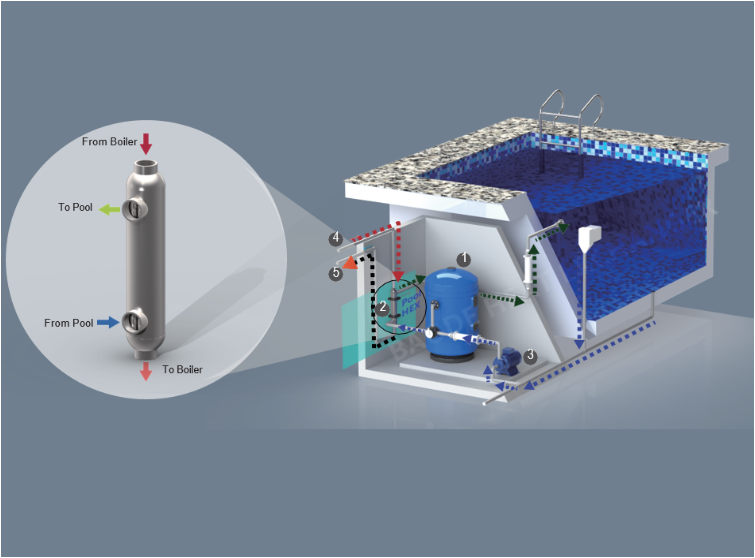
Swimming pool water commonly contains chlorine, bromine, or saltwater generated by electrolysis systems. These chemicals create corrosive operating conditions.
Titanium shell and tube heat exchangers are especially common in saltwater pools because of their outstanding corrosion resistance.
Even well-maintained pools contain small particles such as hair, sand, and organic debris. Shell and tube heat exchangers have larger flow passages, making them less sensitive to these contaminants.
Brazed plate heat exchangers use narrow channels that can clog more easily if filtration is imperfect.
Shell and tube designs allow mechanical tube cleaning and chemical flushing. This maintenance flexibility is valuable for long-term pool operation.
BPHE units are sealed designs and cannot be mechanically cleaned if fouling becomes severe.
Shell and tube heat exchangers have been used in pool heating systems for decades. Their robust structure tolerates fluctuating water chemistry and varying maintenance standards.
| Feature | Shell & Tube | BPHE |
|---|---|---|
| Corrosion Resistance | Excellent with titanium | Moderate |
| Fouling Tolerance | High | Lower |
| Maintenance | Easy cleaning | Limited |
| Service Life | Long | Shorter in pool duty |
Although brazed plate heat exchangers offer compact design and high heat transfer efficiency, shell and tube heat exchangers remain the preferred solution for swimming pool heating because they are more durable, easier to maintain, and better suited to chemically treated pool water environments.
Yes, brazed plate heat exchangers can technically be used in swimming pool heating systems. However, they are generally less preferred because pool water often contains chlorine or salt, which may attack copper brazing materials over time.
Titanium offers excellent resistance to chloride corrosion, which is common in saltwater pools. This makes titanium shell and tube heat exchangers one of the most durable solutions for pool heating applications.
Yes, shell and tube heat exchangers are typically larger than brazed plate heat exchangers. However, the increased size provides larger flow passages, better fouling tolerance, and easier maintenance.
A titanium shell and tube pool heat exchanger can often operate for 15–20 years under proper water chemistry control and maintenance conditions.
Titanium is widely considered the best material for swimming pool heat exchangers, especially for saltwater pools. Copper-nickel and stainless steel may also be used in less aggressive environments.